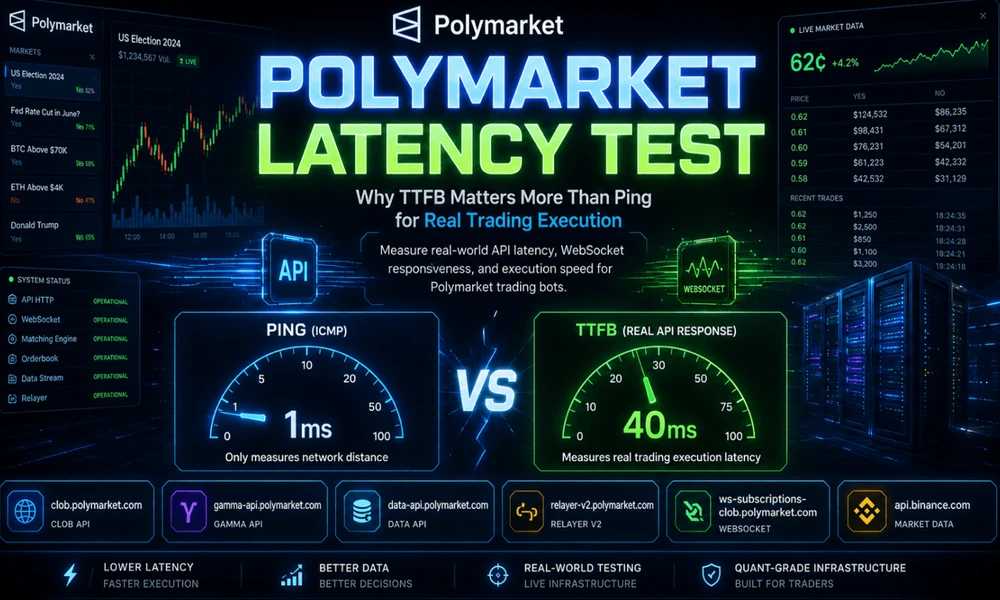
The majority of new Polymarket traders make the same mistake when optimizing their trading infrastructure. They open a terminal, run a simple ping test against an API endpoint, see a low millisecond result, and assume their execution speed is optimized. In reality, professional trading systems do not care much about ICMP ping results. What actually matters in live prediction market trading is how quickly your infrastructure can communicate with the real Polymarket trading stack, receive data updates, submit orders, and receive execution responses under actual HTTPS and WebSocket conditions.
This is why serious quantitative traders, arbitrage traders, market makers, and high-frequency automation systems increasingly focus on TTFB instead of raw ping numbers.
TTFB, or Time To First Byte, measures the real-world response speed of the infrastructure you are actually trading through. Unlike ping, TTFB includes DNS resolution, TCP connection establishment, TLS negotiation, CDN routing, API gateway processing, backend application handling, and the time required for the first byte of data to return to your VPS. In practical Polymarket trading, this measurement is dramatically more important than a simple network round-trip time.
As prediction markets become more competitive and more automated trading systems enter the ecosystem, execution latency becomes one of the largest competitive advantages. Traders who receive order book updates faster can react sooner. Traders who submit orders faster can capture liquidity before others. Traders with lower real-world latency can exploit temporary inefficiencies that slower systems never even detect.
This is especially important on Polymarket because the platform relies heavily on modern API infrastructure, Cloudflare routing layers, HTTPS communication, and real-time WebSocket subscriptions. The actual execution path of a trade is significantly more complex than a simple ping packet traveling across the internet. Understanding this difference is essential for anyone building serious trading infrastructure.
Why Ping Is a Misleading Metric for Trading
Ping is useful for basic network diagnostics, but it is a poor benchmark for measuring trading performance. When you run a ping test, your system sends a small ICMP packet to a remote server and measures how long it takes to receive a reply. This only measures raw network travel time between two endpoints.
In trading infrastructure, however, almost nothing operates through ICMP. Polymarket trading systems communicate using HTTPS APIs and WebSocket streams. Every request must pass through multiple layers of networking and application infrastructure before the exchange responds. This means the number you see in a ping test often has little relationship to your real execution latency.
For example, a VPS might show a ping latency of 1 milliseconds to a nearby Cloudflare edge node, but when your trading bot submits an actual HTTPS request to place an order, the real response time could exceed 80 milliseconds after accounting for TLS handshakes, CDN processing, backend routing, and API execution. Another VPS located farther away may show a higher ping result while still delivering significantly faster real-world API responses due to better routing quality and superior peering relationships.
This is one of the main reasons experienced algorithmic traders rarely rely on ping results alone. Real execution performance depends on the entire networking stack rather than just physical packet travel time.
Understanding TTFB in Real Trading Environments
TTFB, or Time To First Byte, measures the time between initiating an HTTP request and receiving the first byte of the server’s response. This metric reflects the actual experience of a trading application communicating with exchange infrastructure.
When your Polymarket trading bot sends a request to retrieve order book data, place a limit order, fetch market metadata, or subscribe to market updates, several things happen almost instantly behind the scenes. DNS systems resolve the endpoint hostname. TCP sessions are created. TLS encryption is negotiated. Cloudflare edge infrastructure determines routing paths. Backend API gateways process authentication and rate-limiting. Internal services communicate with the trading engine. Finally, the response begins returning to your VPS.
All of these stages contribute to actual trading latency.
TTFB measures this entire chain much more accurately than ping ever could. This is why professional traders consider TTFB one of the most realistic indicators of practical execution performance.
For modern prediction market systems, where opportunities may only exist for fractions of a second, lower TTFB can directly improve profitability. Faster infrastructure can capture liquidity sooner, respond to market changes more quickly, and maintain more competitive market-making spreads.
Why TTFB Is Critical for Polymarket Trading Bots
Polymarket trading infrastructure is highly dependent on API responsiveness. Every important function within a trading bot interacts with remote infrastructure through APIs or WebSocket streams. Market makers constantly update quotes based on incoming order book changes. Arbitrage systems compare prices between multiple exchanges in real time. Sniper bots monitor newly listed markets and rapidly submit orders before liquidity shifts. Data collection systems continuously ingest market information for analytics and strategy generation.
In all of these cases, slower TTFB creates competitive disadvantages.
A trading system with high TTFB receives information later than competing systems. It reacts later to order book changes. It submits orders later. It experiences delayed confirmations. During periods of high market volatility, these delays can significantly impact profitability.
This becomes especially important in fast-moving political events, crypto-related prediction markets, breaking news markets, and highly volatile event-driven trading conditions. In these environments, milliseconds matter because liquidity conditions can change extremely quickly.
Many newer traders underestimate how much backend infrastructure influences execution quality. They optimize only for low ping numbers while ignoring actual API responsiveness. In practice, the trader with superior TTFB usually has the faster real-world trading system.
Core Infrastructure Endpoints Used in Polymarket Trading
Professional Polymarket trading systems rarely communicate with only one endpoint. Instead, advanced trading infrastructure interacts with multiple services simultaneously. Each endpoint serves a different role in the ecosystem and contributes differently to execution latency.
1. CLOB Trading Endpoint
This is the primary trading infrastructure.
Used for:
- Order placement
- Order cancellations
- Market data
- Order books
- Trading APIs
- Matching-related requests
For active trading bots, this endpoint is the most latency-sensitive component.
2. Gamma API
The Gamma API provides:
- Market metadata
- Event information
- Market listings
- Token details
- Resolution data
- Market discovery
Many trading bots continuously monitor Gamma for new markets and event updates.
3. Data API
Used for:
- Historical data
- Market analytics
- Price history
- Candlestick data
- Volume analysis
Quantitative traders often use this endpoint for strategy modeling and statistical analysis.
4. Relayer Infrastructure
The relayer infrastructure handles critical backend coordination for order flow and execution.
This layer can significantly impact practical trading latency.
5. Binance API
Many advanced Polymarket traders simultaneously monitor Binance pricing.
This is especially common for:
- Event-driven markets
- Crypto-related prediction markets
- Correlation strategies
- Arbitrage systems
Low-latency communication between Binance and Polymarket infrastructure is extremely important for cross-exchange trading systems.
6. WebSocket Subscription Infrastructure
This endpoint powers real-time updates including:
- Order book updates
- Trade executions
- Fill notifications
- Market changes
- Liquidity updates
For high-frequency systems, WebSocket responsiveness is often even more important than REST API speed.
How to Select the Best VPS Location for Polymarket Trading
Choosing the right VPS location for Polymarket trading is one of the most misunderstood parts of building a profitable trading infrastructure. Many traders assume the closest geographic location automatically provides the fastest execution speed, but in real-world trading environments this is often not true. Modern exchange infrastructure depends heavily on CDN routing, HTTPS processing, Cloudflare edge behavior, backend API infrastructure, and WebSocket propagation speed. Because of this, the “best” VPS location is not necessarily the location with the lowest ping result.
For serious Polymarket trading, the goal is not simply to achieve low ICMP latency. The real objective is to reduce practical execution delay between your trading bot and Polymarket’s live infrastructure. This includes how quickly your VPS can receive market updates, process WebSocket streams, communicate with API endpoints, and submit orders during high market activity.
Many traders discover that a VPS with slightly higher ping numbers can still outperform another VPS in real trading conditions because its TTFB, API routing quality, and WebSocket consistency are significantly better.
This is why selecting a Polymarket VPS location should always be based on real-world latency testing rather than theoretical distance.
How to Test Real Trading Latency for Polymarket
The most accurate method for evaluating Polymarket VPS performance is measuring TTFB against the real trading endpoints used by your bot. Unlike ping tests, TTFB measures actual HTTPS response behavior including routing, TLS negotiation, CDN handling, and backend processing.
The easiest way to benchmark TTFB is using curl.
Below is a real example for testing the main Polymarket CLOB infrastructure:
curl -o /dev/null -s -w
‘TTFB: %{time_starttransfer}nTotal: %{time_total}n’
https://clob.polymarket.com
This command measures:
- Time required to establish the connection
- HTTPS/TLS negotiation speed
- CDN routing performance
- API response initiation time
- Overall request responsiveness
This gives a much more realistic measurement of actual trading latency.
For serious testing, traders should benchmark multiple endpoints repeatedly over time instead of relying on a single result.
Important Polymarket Endpoints to Benchmark
Professional Polymarket bots usually interact with multiple services simultaneously, so all major endpoints should be tested individually.
Main CLOB Trading Infrastructure
curl -o /dev/null -s -w ‘%{time_starttransfer}n’
https://clob.polymarket.com
This endpoint is the most important because it handles order books, market data, and trading requests.
Gamma API
curl -o /dev/null -s -w ‘%{time_starttransfer}n’
https://gamma-api.polymarket.com
Used for market metadata, event discovery, and token information.
Data API
curl -o /dev/null -s -w ‘%{time_starttransfer}n’
https://data-api.polymarket.com
Important for historical datasets and analytics systems.
Relayer Infrastructure
curl -o /dev/null -s -w ‘%{time_starttransfer}n’
https://relayer-v2.polymarket.com
This endpoint is closely related to backend order flow infrastructure.
Binance API
curl -o /dev/null -s -w ‘%{time_starttransfer}n’
https://api.binance.com
Many advanced Polymarket traders monitor Binance simultaneously for correlation strategies and crypto-event arbitrage.
Why TradingVPS Is Optimized for Polymarket Trading
At TradingVPS, our infrastructure is specifically designed for latency-sensitive trading applications including Polymarket automation systems.
Our Amsterdam and Dublin VPS infrastructure is optimized for:
- Low-latency API communication
- Stable Cloudflare routing
- High-performance HTTPS connectivity
- Reliable WebSocket performance
- Fast single-core CPU execution
- Low scheduling latency for trading bots
For advanced Polymarket traders running:
- market-making bots
- sniper bots
- arbitrage systems
- liquidity strategies
- quantitative trading engines
stable execution performance is critical.
This is why we continuously benchmark and optimize routing quality instead of focusing only on theoretical ping results.
Our Amsterdam VPS Real Trading Latency(TTFB)
Our Dublin VPS Real Trading Latency(TTFB)
Final Thoughts
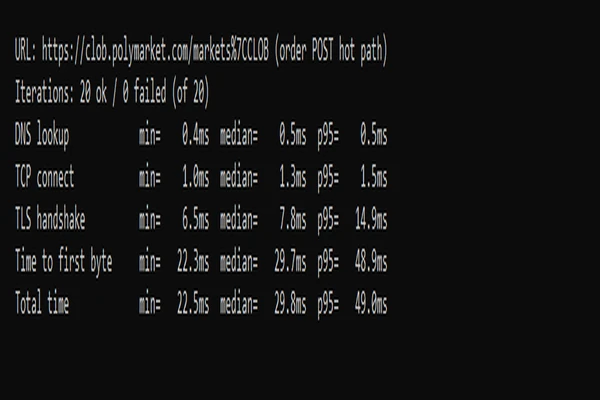
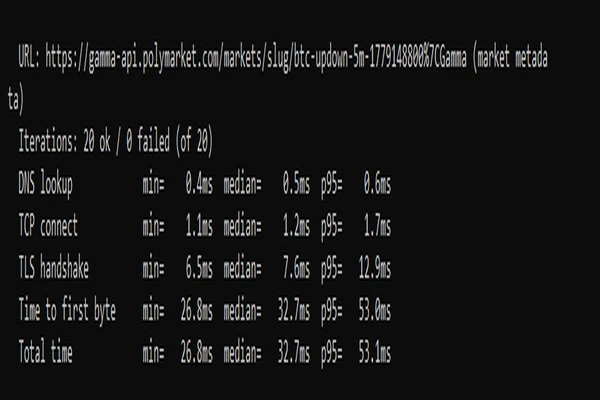
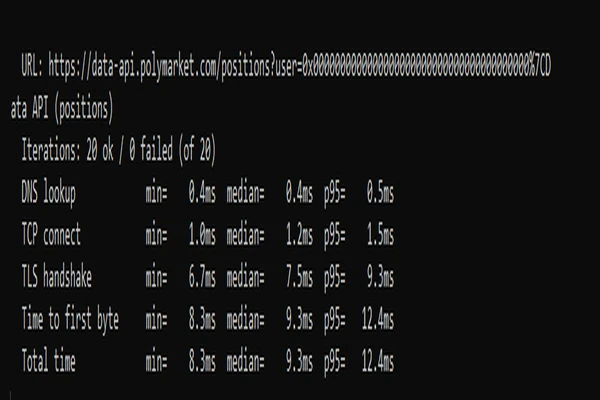
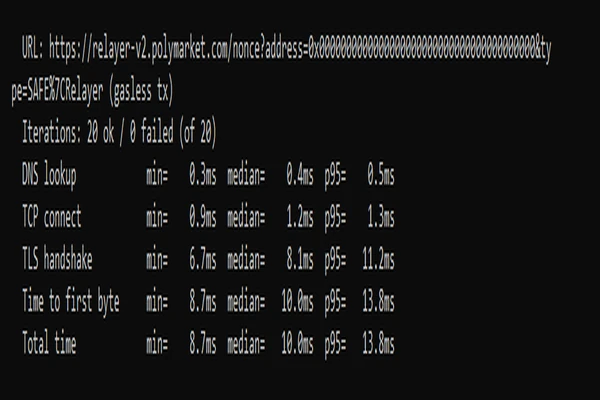
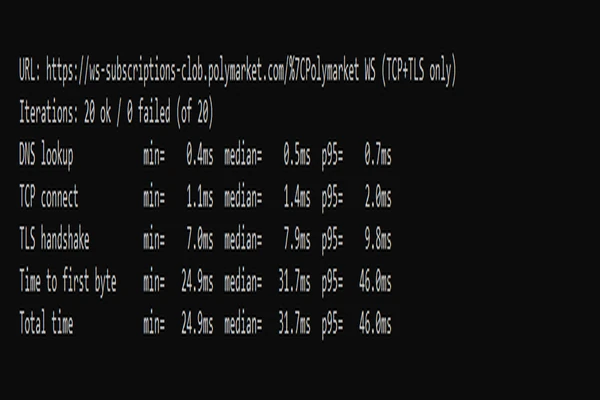
Modern prediction market trading infrastructure is far more complex than simple network ping measurements. Real execution performance depends on API responsiveness, routing quality, WebSocket propagation speed, CDN behavior, backend processing, and VPS hardware performance working together as a complete system.
This is why experienced Polymarket traders increasingly optimize for TTFB rather than relying only on ping tests.
A VPS with slightly higher ping but lower real-world TTFB often delivers substantially better execution performance during live trading conditions. Faster API responsiveness leads to quicker reactions, better liquidity capture, improved arbitrage opportunities, and more competitive automated execution systems.
For serious Polymarket traders building market-making bots, arbitrage infrastructure, sniper systems, liquidity engines, or quantitative trading platforms, understanding real execution latency is no longer optional. It is one of the most important competitive advantages in modern prediction market trading.
FAQs
1. What is the difference between ping and TTFB in Polymarket trading?
Ping measures the raw network round-trip time between your VPS and a remote server using ICMP packets. TTFB, or Time To First Byte, measures the actual response speed of real HTTPS requests including DNS lookup, TLS negotiation, CDN routing, backend processing, and API response generation. For Polymarket trading, TTFB is usually a much more accurate indicator of real execution latency.
2. Why is TTFB more important than ping for Polymarket trading bots?
Polymarket trading bots communicate through HTTPS APIs and WebSocket infrastructure rather than simple ICMP packets. TTFB reflects the actual latency experienced when fetching market data, submitting orders, receiving responses, and interacting with Polymarket infrastructure. Lower TTFB usually results in faster execution and quicker market reactions.
3. What VPS location is best for Polymarket trading?
The best VPS location depends on real-world API responsiveness rather than theoretical geographic distance. Many advanced traders benchmark Amsterdam and Dublin VPS infrastructure directly using Polymarket endpoints to determine which location performs better for their trading systems.